NASA just released
new, ultra-clear images of Ceres' mysterious bright spots
What the hell is going on down there?
Last year, Ceres - a dwarf planet that sits
between Mars and Jupiter - was the subject of intense debate as researchers all
over the world tried to figure out what formed the planet’s mysterious white
spots. Though that mystery is now pretty much solved, NASA’s Dawn
spacecraft just sent back some of the clearest pictures of these bright spots
ever taken.
The new pictures, which were unveiled at the
47th annual Lunar and Planetary Science Conference in Texas, were taken from a
distance of 385 kilometres (240 miles) above the Occator Crater, a hole on the dwarf planet’s
surface that stretches 92 kilometres across and 4 kilometres deep (57 x 2
miles).
"Before Dawn began its intensive observations of Ceres last
year, Occator Crater looked to be one large bright area. Now, with the latest
close views, we can see complex features that provide new mysteries to
investigate. The intricate geometry of the crater interior suggests geologic
activity in the recent past, but we will need to complete detailed geologic
mapping of the crater in order to test hypotheses for its formation."
Besides the crater photos, the team has also released a colour map
of Ceres' surface that highlights what materials the dwarf planet’s made of and
how craters are distributed around it. This data will help researchers
understand what lies blow the Ceres' surface.
NASA/JPL-Caltech/UCLA/MPS/DLR/IDA/PSI
They also revealed that water has been found
in the Oxo Crater by the visible and infrared mapping spectrometer (VIR), which
is always big news. It turns out that Ceres is full of little mysteries other
than its well-known, bright salt patches.
The new data will enable researchers to
further understand how Ceres formed, how much water is hidden there and, of
course, more information on its weird regions like Occator Crater.
"We're excited to unveil these beautiful
new images, especially Occator, which illustrate the complexity of the
processes shaping Ceres' surface," said Carol Raymond, deputy principal
investigator for the mission. "Now that we can see Ceres' enigmatic
bright spots, surface minerals, and morphology in high resolution, we're busy
working to figure out what processes shaped this unique dwarf planet."
You can view more of the newly released pictures here.
NASA's developing a
decelerator that would replace parachutes in space vessels
It'll be a rough landing on Mars.
NASA has developed a new decelerator that will
be used in future space missions. It can work in extreme conditions and
withstand packing and compression, resulting in a smaller footprint.
Historically, NASA has used decelerators to
slow down space vessels as they prepare to land on Earth. Housed within the
vessels, these decelerators generate drag and limit acceleration, working like
a parachute.
NASA wants to ensure that decelerators used
in future space missions will work in extreme conditions and withstand packing
and compression. In order to achieve this, the agency created a scaled-down
version of its latest Hypersonic Inflatable Aerodynamic Decelerator, or HIAD, design to ensure that it will be able to tolerate
the packing process.
Using a vacuum pump, NASA engineers were
able to squeeze the 3-metre, donut-shaped inflatable into a vastly smaller
space, an important quality considering the space premium in vessels. They then
packed and unpacked it multiple times, checking for tears in its Zylon and
Teflon materials at every step in the process.
NASA
Engineers at NASA foresee the viability of
this technology in delivery of heavy cargo, science instruments, and people to
other worlds. It could even be used to recover cargo from the International
Space Station and return it to Earth.
According to Langley test engineer, Sean Hancock, HIAD
was packed the same way each time to see how the material would handle folding,
packing, and compressing. In doing so engineers develop a better understanding
of how it would perform after exposure to handling, storage, and deployment
during a space flight mission.
This development is also of great concern to
NASA, as it anticipates future missions, especially manned ones, will require
heavier vessels and ships. While a parachute has been used to bring down the
Curiosity rover through the Martian atmosphere, a spacecraft containing
astronauts and other materials could weigh 30 times more, necessitating better
decelerators.
The HIAD would allow a slower descent of
any vehicle through the atmosphere during future missions. In addition, the
technology will protect the craft from the intense heat on the journey down.
HIAD lead engineer, Keith Johnson, explained that the small test donut
contained all the components for the latest design.
This test should allow NASA to develop a
bigger prototype and bring us one step closer to settling the Red Planet.
This article was originally published by Futurism. Read the original article.
Saturn's moons and
rings could be younger than the dinosaurs, study reveals
100 million years, cosmically speaking, is
super young.
When researchers talk about planets and moons
forming, it’s usually an event that took place billions and billions of years
ago - a timeframe that's so massive, it's hard for us to really comprehend. But
that can no longer be said about Saturn’s famous moons and rings, because they
might have formed a mere 100 million years ago, which makes them younger than
most dinosaurs.
According to researchers from the Search for Extra-terrestrial Intelligence Institute (SETI),
a new computer model shows evidence that Saturn’s inner moons and rings are
actually a relatively modern creation, especially considering that Saturn
itself, along with the other planets in our Solar System, formed some 4.5
billion years ago.
The discovery came from analysing orbital data
from the planet’s moons. Basically, since Saturn has so many moons flying around it, they have to
share space, which means that the orbits of these moons are affected by each
other. As time goes on, these orbits stretch out and grow.
So, based on that logic, the younger moons
should have different, more ordinary orbits than the older moons, if they
actually had billions of years to get weird. As SETI puts it:
"By comparing present orbital tilts and those predicted by
computer simulations, the researchers could learn how much the orbits of
Saturn’s moons grew. It turns out that for some of the most important
satellites - Tethys, Dione, and Rhea - the orbits are less dramatically altered
than previously thought."
With that observation, the researchers used
data from NASA’s Cassini mission data to create simulations.
When all was said and done, the team found
that many of Saturn’s moons - except the faraway ones like Titan - likely formed
100 million years ago, meaning that many of Saturn’s moons formed during
Earth’s Cretaceous Period, the era during which many of your favourite
dinosaurs were alive.
It's hoped that the findings will help us
judge the ages of other moons inside our Solar System and out.
It’s pretty crazy to think that moons were
forming in our Solar System during a time on Earth that many of us can actually
envision. It’s still a super-long time ago, but, cosmically speaking, it's like
it only happened yesterday.
3 billion years ago, our Moon had a different north
pole
Like if Earth's axis moved from Antarctica to Australia.
It's easy to think of the Moon as a kind of dormant, predictable companion to
all the hustle and bustle of life on our home planet, but a new study reveals
there's a whole lot more going on under the surface of our lunar satellite than
we might assume.
Scientists have discovered that the Moon wandered off its original axis more
than 3 billion years ago, with the axis shifting about 6 degrees over the course
of a billion years or so. That means the north and south poles of the Moon
weren't always where they are right now.
"This was such a surprising discovery. We tend to think that objects in the
sky have always been the way we view them, but in this case the face that is so
familiar to us – the Man on the Moon – changed," says
planetary scientist Matthew Siegler from the Southern Methodist University
in Dallas.
Siegler and his colleagues found evidence of the lunar shift while analysing
NASA records of lunar polar hydrogen. The hydrogen is contained in ice deposits
hidden in craters around the Moon's north and south poles, and the researchers
detected an unusual offset of these ice deposits from the Moon's current north
and south poles.
Taking a closer look at the data – gleaned from NASA's Lunar Prospector and
Lunar Reconnaissance Orbiter missions – they found the ice offset at each pole
amounted to the same distance, but travelling in exactly opposite directions.
James
Keane/University of Arizona In other words, the axis that runs through the Moon and around which it
rotates had shifted in position, with the north and south poles adjusting to new
locations on the lunar surface. While 6 degrees might not seem like a huge
angle, it's a pretty massive transformation for something as big as the Moon.
But how did it happen?
The answer, according to the researchers, is volcanic activity that took
place under the lunar surface a long, long time before humans started gazing up
at the Moon.
"Billions of years ago, heating within the Moon's interior caused the face we
see to shift upward as the pole physically changed positions," said
Siegler. "It would be as if Earth's axis relocated from Antarctica to
Australia. As the pole moved, the Man on the Moon turned his nose up at Earth."
The phenomenon, called polar wander, is thought
to have occurred when ancient volcanic activity some 3.5 billion years ago
melted some of the Moon's mantle, leading it to bubble up toward the surface.
This change in internal mass could have caused the whole Moon to move, slowly
shifting the position and angle of its axis over a billion years, as now shown
by etched ice paths on the surface.
The findings, published in Nature,
help us to understand more about the nature of ice on the Moon, as we now know
it predates the Moon's polar wander, indicating that it's very ancient. This in
turn could help explain how we have water here on Earth, which is something that
still puzzles scientists.
"We don't know where the Earth's water came from. It appears to have come
from the outer Solar System well after the Earth and Moon formed," said
Siegler. "The [Moon] ice may be a time capsule from the same source that
supplied the original water to Earth. This is a record we don't have on Earth.
Earth has reworked itself so many times, there's nothing that old left here.
Ancient ice from the Moon could provide answers to this deep mystery."
This open-access picture book from the ‘70s shows how
glorious the space race really was
Unbounding optimism.
The ‘70s were an exciting time for space exploration. We landed on the Moon
in 1969, the Russian Mars 2 probe explored the surface of the red planet in
1973, and things were looking bright for future of space travel.
These recently uploaded - and incredible to look at - illustrations tell the
story of the space race, showing just how optimistic we all were back then, as
well as some of the cutting edge research and technology from the time.
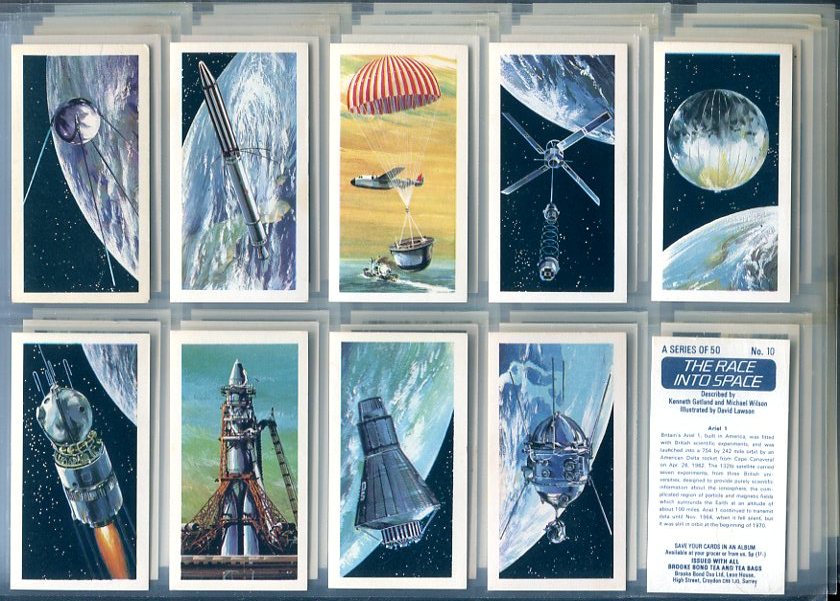
English tea brand, Brooke Bond & Company, jumped on the space race
bandwagon in 1971, creating a book and collectible tea card set about "The Race
to Space". The book contained 50 tea cards - just like collectable baseball
cards - based on different probes we’d sent out into the Solar System so far,
such as the Apollo Lunar Module, the Lunar Roving Vehicle, and a hypothetical
future manned flight to Mars.
Although we still haven’t actually made it to Mars yet, we definitely admire
their
optimism. Enquiring young minds could get these 50 tea cards by purchasing,
as their namesake suggests, boxes of tea. Each packet of loose tea from Brooke
Bond came with one of these cards, kind of like an even older-school version of
those dumb toys you could get in cereal boxes and packets of chips (anyone
remember Pogs?!).
Brooke
Bond These weren’t the first tea cards on the market, and certainly weren’t the
last, with collectable cards spanning British Birds in 1964 all
the way to 1999’s Oracle cards. When the Oracle cards got hot (like, say, by
holding one over a cup of tea) the heat would change the card to revel a
prediction. But 1971’s "The Race into Space" collection is definitely our
favourite series, and we love all these incredible images of humankind’s journey
into the cosmos.
You can see more high quality images and excerpts all
free on Flickr.
Brooke
Bond But if reading is more your thing, IF Magazine is
another science blast from the past that we can’t get over. Launched in March
1952 by Quinn Publications, the science fiction magazine was only ever
moderately successful during its relatively short run, but the amazing
illustrations and stories inside are timeless, and give a great insight into
what we thought the future would look like, from more than half a century ago.
Check out the whole collection here.
IF Magazine, Jason
Scott
NASA by 2022... for just $10 billionscientists say we could colonise the Moon
What are we waiting for ?
A lot of focus over the past 12 months has been on NASA's journey to Mars. But a group of space experts, including leading NASA scientists, has now produced a special journal edition that details how we could establish a human colony on the Moon in the next seven years - all for US$10 billion.
Although that's pretty awesome, the goal isn't really the Moon itself - from an exploratory point of view, most scientists have bigger targets in sight. But the lessons we'll learn and the technology we'll develop building a human base outside of Earth will eventually be the key to colonising Mars, and other planets, according to the experts.
The journal articles came out of a workshop held back in August 2014, when some of the greatest minds in space research and business were brought together to explore and develop low-cost options for building a human settlement on the Moon.
We haven't gone back to the Moon since 1972 simply because of how expensive it is - the Apollo program that put the first humans on the lunar surface would have cost US$150 billion by today's standards, Fecht reports. And with a budget of US$19.3 billion for the whole of 2016, NASA hasn't been able to consider the Moon as well as Mars.
But thanks to new technology, it no longer has to be that way.
"The US could lead a return of humans to the surface of the Moon within a period of 5-7 years from authority to proceed at an estimated total cost of about $10 billion (±30 percent)," conclude NASA's Alexandra Hall and NextGen Space's Charles Miller in one of the papers.
"The big takeaway," McKay told Popular Science, "is that new technologies, some of which have nothing to do with space - like self-driving cars and waste-recycling toilets - are going to be incredibly useful in space, and are driving down the cost of a moon base to the point where it might be easy to do."
NASA
According to the research papers, the lunar base would house around 10 people for stays of up to a year at first - and could eventually grow to a self-sufficient settlement of 100 within a decade.
They'd get to the Moon on SpaceX's soon-to-be-launched Falcon Heavy, and while they'd have to take quite a lot of equipment on the first trip, 3D printing could be used to produce pretty much everything else once they get there.
The colony would most likely be established on the outer rim of one of the Moon's poles, which receive more sunlight than the rest of the surface, so would help keep solar-powered equipment running. As Marketwatch reports:
"Furthermore, all that energy could provide power for robots that would excavate large amounts of ice detected within the craters. Water gathered that way could then be used for life support, as well as for providing oxygen, or it could be processed into rocket fuel, which would be sold or stored for refuelling space crafts."
The astronauts would probably live in the something similar to Bigelow Aeropsace's inflatable habitat, the researchers write, which is radiation resistant and would allow for a range of living areas, as well as easy storing and transport.
It could also provide protected habitats for basic crops, which would be fertilised with the help of a toilet that recycles human waste into energy, clean water, and nutrients, such as the Gates Foundation-funded blue toilet.
It all sounds amazing, but the elephant in the room is the fact that the US$10 million establishment cost is more than NASA's existing space flight budget of US$3-4 billion per year. But assuming setting up the colony is a flat fee, it's definitely still affordable and could run alongside plans to Mars, the scientists write.
And things could get even cheaper if commercial service providers are involved, which would then be prime position to sell propellant from the Moon's orbit to NASA and any other space agencies trying to get humans to Mars.
All of the papers in the special edition of New Space are freely available online for you to peruse and use to plan your future in space. Get dreaming, because it's closer than you think.
"It is time to go back to this Moon, this time to stay," concludes the journal's preface. "and funding is no longer the main hurdle."
Flash of light alerts
astronomers to the strangest planetary orbit ever observed
Like a deep space slingshot.
Astronomers have discovered the most unusual
planetary orbit ever, given away by a flash of reflected light beamed back by
the planet's atmosphere.
While most planets (including those in our
Solar System) have roughly circular orbits, researchers have spotted some
exceptions that form an elliptical path around their star. The newly discovered
planet HD 20782 has the weirdest one yet: a long, flat ellipse that takes the
planet way out into space before it 'slingshots' around its star at a very
close distance.
Consider the distance between Earth and the
Sun, around 149 million km (93 million miles). At the most distant point, HD
20782 and its star are 2.5 times further apart than this - at their closest
point, they're just six-hundredths of the same distance from each other (that's
much closer than Mercury is to the Sun).
Weigh those distances up, and you can begin to
see just how unusual this planet's orbit is.
A team from researchers from San Francisco
State University used a satellite-based telescope to catch a flash of
reflected light from HD 20782's atmosphere as it flew around its star, thus
helping to confirm the path the planet is taking.
Unlike other planets, HD 20782 doesn't have
time to react to the brightness of its star. Icy materials in the atmosphere
are what make a planet reflective, but you would expect these materials to burn
up as they get close to a star. In the strange case of HD 20782, there isn't
time for that to happen.
"[The planet is] around the mass of
Jupiter, but it's swinging around its star like it's a comet," said lead researcher Stephen Kane.
Now the question is: what caused HD 20782's unique
orbit? It might have collided with another planet, Kane's team suggests, or the
gravitational pull of another star might have something to do with it.
"When we see a planet like this that is
in an eccentric orbit, it can be really hard to try and explain how it got that
way," Kane says. "It's kind of like looking at
a murder scene, like those people who examine blood spatter patterns on the
walls. You know something bad has happened, but you need to figure out what it
was that caused it."
HD 20782, which is some 117 light-years away
from Earth, offers a "particularly lucrative observing
opportunity", according to the astronomers. Now they want to
gather more data to understand how the planet handles such a brief and
blistering close encounter with its sun, and to look more closely at the
planet's atmosphere.
See the graphic below, which shows the orbit
of the planet HD 20782 relative to the inner planets of our Solar System. HD
20782's orbit more closely resembles that of a comet than a planet.
10 Videos to Give You New Perspective on the Universe
As we’ve mentioned a few times before, the fact that we are alive here isastonishing. In order to demonstrate exactly how amazing it is, we’ve rounded up a collection of videos that show our remarkable journey from the Big Bang, to the creation of the solar system, to the formation of the Earth, and finally the rise of humanity.
10. The History of the Universe
According to estimates from astrophysicists, the universe is 13.7 billion years old and started with the Big Bang. In the first moments after the Big Bang, the universe was almost impossibly tiny. In a fraction of a second after the Big Bang, there was a period known as inflation and the universe grew to the size of an orange. Then three to 20 seconds after the Big Bang, the universe started to cool and expand, and hydrogen and helium, the simplest chemical elements, were born.
380,000 years after the Big Bang, the universe became transparent. After 400 million years of darkness, the first stars started lighting up. Then 300 million years later, when the solar system was only 700 million years old, galaxies began to form. Our solar system didn’t form until 9 billion years after the Big Bang. That means that our solar system is actually quite young in the universe, and just for some perspective of how young, please check out the simulation of the creation of the universe posted above.
9. The Known Universe
The video for this entry, from the American Natural History Museum, was created using their Digital Universe Atlas. The atlas is an ongoing project where researchers are mapping out the observable universe, and all the planets and stars are correct to scale. The simulation starts off in the Himalayan mountains and after a short time, Earth disappears into the distance as the simulation pushes us out billions of light years away from Earth.
What is perhaps more amazing than the size of the known universe is that by estimates, we only see four percent of the universe. The rest of the universe is full of mysterious substances called Dark Matter and Dark Energy. Yet, that four percent we do see is unfathomably big, even when we see a simulation of it.
8. The Size of Earth Compared to Other Stars and Suns
For millennia, the Earth was too big to consider traversing even small parts of it. Even with modern air travel, it still takes two days and 19 hours to circumvent it in a plane. But in cosmic terms, the Earth is actually rather small and there are four other planets in our solar system that are much bigger. As seen in the video above from BuzzFeed Blue, five Earths could fit into the ring of Saturn and compared to Jupiter, Earth looks like a marble because Jupiter is 11.2 times the size of Earth. When compared to the sun, the Earth is a barely visible dot because the sun is 109 times larger. But our sun is an insignificant speck compared to an Alpha Scorpii A. star, which is 700 times the diameter of the sun, and that isn’t even the biggest known star. That title belongs to the VY Canis Majoris, which is 1,540 times the size of the sun. If VY Canis Majoris was in the place of our sun, it would extend out past the orbit of Saturn.
What’s even more mind blowing is that stars are tiny compared to galaxies. For example, our galaxy, the Milky Way, is 100,000 light years in diameter, meaning it is about 678 trillion times the size of the sun. And again, that is small in comparison; the IC 1011 galaxy is 6 million light years wide, or 60 times the size of the Milky Way.
7. The Solar System and the Formation of the Earth
Our solar system has at least eight planets and five recognized dwarf planets that orbit a yellow dwarf star. Before our solar system existed, there was a cloud of helium, hydrogen, dust, and then over 4.5 billion years ago, a nearby star exploded in what is called a supernova, which caused the cloud to collapse. Over the course of 100,000 years, the cloud was flattened into a disc.
In the center of the disc, where the molecules are packed tightest, a proto-star developed and it got so hot that it underwent fusion, giving birth to our sun. The heat from the sun turned the dust into rocks and a number of these rocks clumped together, starting the formation of Earth.
6. How Deep is the Ocean
Around 4.5 billion years ago, the Earth first formed under heat and pressure and was bombarded with asteroids, meteors, and comets. It had an atmosphere that was poisonous and too hot for water to remain on the surface. A second atmosphere was made because of constant volcanic eruptions, and gases like methane and carbon dioxide were pumped into the atmosphere.
Then about 4.1 billion years ago, the Earth’s surface started to cool and the surface became rocky, which allowed rainwater to fill the oceans. The oceans are an amazing part of Earth and it is a requirement for life. Have you ever thought about how deep the ocean actually is? The video from BuzzFeed Blue gives an interesting cartoon to give some perspective on just how far down it goes.
5. How Tall is Mount Everest
ADVERTISEMENT
On the other end of the spectrum from the deepest part of the ocean is the highest land point, which is the peak of Mount Everest, located in the Himalayas. Its creation started over 250 million years ago when the Earth had one continent called Pangaea. At the time, what is now India was in the Southern Hemisphere, attached to what are today Australia, South America, and Africa. After the super continent broke up, India spent millions of years moving towards its present day home in EuroAsia. When India hit the continent, it acted like a bulldozer and it pushed up the mountain range about 60 million years ago.
Mount Everest is 29,035 feet tall, more than 10 times higher than the world’s tallest building, the Burj Khalifa in Dubai. To get an even better idea as to how tall it is, check out the video above. Also, in case you’re wondering what the distance from the lowest depth to the highest mountain peak, it is 65,236 feet, or 12.35 miles.
4. The Migration of Humans
Homo sapiens first appeared about 200,000 years ago and they most likely came from a single point in Africa. Around 130,000 years later, the weather changed because the Earth was in an ice age, and it is believed that the number of humans dwindled to just under 10,000. Luckily for us, the weather got better and human numbers went up.
60,000 years ago, the first group of humans left Africa. They migrated along the North Indian Ocean, through what is now the Middle East, Pakistan, India, and Southeast Asia. 10,000 years after leaving, they reached Australia. A second group left Africa around 50,000 years ago, crossed the Red Sea and then over the next 15,000 years became the populations of the Middle East and Central Asia.
About 40,000 years later, humans migrated to Europe from the Southeast. Then about 20,000 years ago, during the Last Glacial Maximum, a group of Asian hunters were able to cross a land bridge connecting Asia with North America because ice sheets in the North and South Poles had sucked up water, decreasing sea levels by more than 300 feet. 15,000 years ago, the Asian hunters reached the land surface of North America, and then within 1,000 years they made it all the way to the southern part of South America.
When agriculture was discovered 10,000 years ago, it became a cornerstone of human civilization and the first civilization is believed to have started about 6,000 years ago in Mesopotamia, which is modern day Iraq.
3. Time Lapse From the International Space Station
The discovery of agriculture was a pivotal moment in human history because one farmercould grow food for a group of people, so not everyone was needed for food collection like it was during hunter and gatherer days. This led to a division of labor, which, in turn, led to people being able to do different jobs. Having different jobs led to commerce and since people have never had a history of being fair with each other, this led to the court system and government, which in turn led to religion, and writing. All of this lay the foundation for societies that we live in today.
While humans were an endangered species 130,000 years ago, humans have recovered remarkably. By 1804, there were 1 billion people living on Earth. That population doubled 123 years later in 1927. In 1960, the population reached 3 billion and just 14 years later there were 4 billion people residing on Earth. Then, Earth reached the 5 billion mark in 1987, and surpassed 6 billion in 1999.
When the video above was posted in 2011, the population of the world reached 7 billion people. The video is a time lapse video from the International Space Station that shows both the beauty of the natural Earth, like the Aurora Borealis, and how much of an impact seven billion humans have on the planet.
2. Modern Human Life
One of the amazing things about human life is that we are all individuals with our own thoughts and feelings, yet we all came from the same place. We, and all our ancestors that came before us, were created through the fertilization of an egg from one of billions of sperm. We survived nine months in the womb and were born. We survived infancy and have survived every day until we have gotten to this very point in time.
For a lot of us, and this is especially true the older you get, sometimes it seems that time just flies by. Nothing perhaps represents that more than this video by Frans Hofmeester, who recorded his daughter, Lotte, for 15 seconds every day and then created this video in 2015, when Lotte was 16. It is a perfect metaphor for how quickly our life goes by, even if our lives are short in the cosmic sense.
1. The Future of Humanity
The universe has come a long way in 13.8 billion years. It started off as a tiny speck, then grew to the size of an orange and then expanded to encompass everything we know as existence. It is full of billions of galaxies, and one of those galaxies had a planet with rocky mountains and deep oceans, that was the perfect distance away from a perfect sized star and life developed on it. From that single cell of life, life forms evolved over millions of years, eventually becoming apes, who became homo sapiens and they migrated all over the world. About 10,000 years ago, we started the transition from hunters and gatherers to civilizations and our population has grown steadily since. There are currently 7.4 billion free thinking, emotional beings living on Earth and we all started from the same place. We’ve come so far and yet, there are so many places we have yet to go.
This video features famed silent film star Charlie Chaplin from his first film with sound, The Great Dictator. In it, Chaplin explains the stark beauty of humanity and what we can do when we work together. Because while we’re all individuals, we all come from the same place and all that can be traced back to the microscopic speck at the start of the Big Bang.
Black holes were first theorized by John Michell in 1783, and the theory was pushed forward in 1915 when Albert Einstein published his general theory of relativity, in which he theorized their formation. Their existence wasn’t confirmed until 1971. Since then, research has continued into these mysterious regions that are sprinkled throughout the known universe.
10. Three Types of Black Holes
The first type of black holes is called stellar black holes (pictured above) and they are the smallest of the trio. They are created when a star that is larger than our sun collapses and continues to fall in on itself. While stellar black holes are relatively small, they are incredibly dense. For example, three times the mass of the sun can be packed into the area that is the size of a city on Earth. It is believed that there are a few hundred million stellar black holes in our galaxy.
On the other end of the size spectrum are supermassive black holes. Researchers aren’t sure how they are spawned, but their radius is about the size of the sun and their massesare billions of times greater than the sun. It is believed that they are at the center of galaxies, including our own.
Finally, intermediate black holes are mid-sized black holes. It is believed they are formed when there is a chain reaction collision of stars that are in a cluster. Researchers weren’t even sure that these existed until one was discovered in 2014.
9. What Do they Look Like?
Black holes can’t be observed because nothing, not even light, can escape from their boundaries, known as the event horizon, because the gravity is so strong. What we could observe is gas when it falls into a black hole because it is heated up, which causes the gases to glow. If we had telescopes or satellites to see a black hole up close, it would look like a rotating disk with a black hole in the middle.
8. Colliding Black Holes
On September 14, 2015, twin Laser Interferometer Gravitational-wave Observatory (LIGO) detectors picked up a small chirp from space. It turns out that chirp was a collision 1.3 billion years ago between two black holes a billion light years away. The black holes were about 29 and 36 times the mass of our sun. Before colliding, they circled each other and then in a fifth of a second, they became one black hole with the mass of 62 of our suns. When they combined, some of the mass was converted to energy and the energy emitted was gravitational waves. Gravitational waves were first theorized by Einstein, and they are a disturbance in the cosmos that could cause space-time to stretch, jiggle, and collapse, which would produce ripples of gravity. The problem was that there was no way to detect these gravitational waves and physicists, including Einstein himself, were never really sure they existed.
The discovery has already been hailed as one of the biggest scientific breakthroughs of the past century and Stephen Hawking said it is a key scientific moment that could change how we look at the universe.
7. Time Slows Down Around it
If you’ve seen Interstellar, you’ll know what happens when you travel near a black hole; time slows down. What is incorrect about the film is that the time dilation would not be quite that extreme.
Time dilation is ultimately affected by gravity, the stronger the gravity, the stronger the time dilation. Also, time only slows down once you get near the black hole, once you pass the event horizon, time would stop.
6. What’s at the Center?
ADVERTISEMENT
It is believed that the very center of a black hole is a time space curvature called singularity. As you get closer to singularity, large amounts of matter are crushed and jammed into immensely small and dense space. In fact, in singularity, matter is crushed to the point where it doesn’t even have dimensions. Singularity also grows infinitely bigger the farther objects travel into it. But since the insides of black holes are impossible to observe, singularity is only a theory and some physicists even question if it exists at all.
5. Closest Black Holes
Since black holes are so hard to detect, we aren’t exactly sure where the closest one is. At first, researchers believed the closest one was at the center of the Milky Way, but currently it is believed that V616 Mon (A0620-00) in the Monoceros constellation, about 3,000 light years away is the closest black hole.
4. Energy Source
At first, it was believed that black holes were just energy drains because once something crosses the event horizon, it never leaves. But in the 1970s, Stephen Hawking showed that black holes should also emit power around the event horizon through a radiation, known as Hawking Radiation, and it is produced by quantum fluctuations of empty space. The obvious extension is: would we ever be able to harness that power? Well, some physicists believe that if we overcame the physical problems it would be possible to get energy from a black hole.
In 1983, a team of physicists suggested that an energy collecting device could be dropped in close to the event horizon and then we could simply pull it back up. It would be similar to getting water from a well with a rope and bucket. Obviously, you’d need a very strong bucket and rope to avoid being sucked in by the event horizon. Another way to collect energy would be to stick in “strings” and the radiation would run up it, the way oil runs up a wick in a gas lamp.
3. Could We Create One?
It goes without saying that black holes can be dangerous, so we definitely wouldn’t want to make one on Earth, right? Well, it turns out that we can theoretically make microscopic ones that are harmless. In 2014, using Hawking Radiation, researchers came close tomimicking a black hole in a lab. But at the time of this writing, one has not been created.
2. Evaporate Over Time
In the prior entries we talked about Hawking Radiation, which is energy found at the boundaries of the black hole. What is interesting is that this radiation also causes black holes to evaporate over long periods of time.
Why they evaporate comes down to quantum theory which suggests that virtual particles pop in and out of existence all the time. When they pop into existence, a particle and an antiparticle combine and then they disappear again. But when the two particles pop into existence near the event horizon, they don’t cancel each other out. Instead, one falls into the black hole and the other goes off into space. Over time, the escaping particles cause the black hole to deteriorate. That means black holes die, just like everything else in the known universe. Except for Keith Richards, of course.
1. What Happens When You Fall In
If you were to dive into a black hole that was the size of the Earth, your body would look like “toothpaste” coming out of a tube. Your body would be stretched out in what British astrophysicist, Sir Martin Rees, called “spaghettification.” Eventually, you would become a stream of subatomic particles that would swirl into the black hole. But, if you were to dive into a larger black hole, say one that is the size of our solar system, then your body may be able to hold its structural integrity.
If you survive that, you’ll see the curvature of space-time and you will be able to see everything that fell into the black hole before you and at the same time you’ll be able to see everything that will ever fall into the black hole. This means that you’ll be able to see the entire history of the universe, from the Big Bang to the end of time, all at once.


 NASA/JPL-Caltech/UCLA/MPS/DLR/IDA/PSI